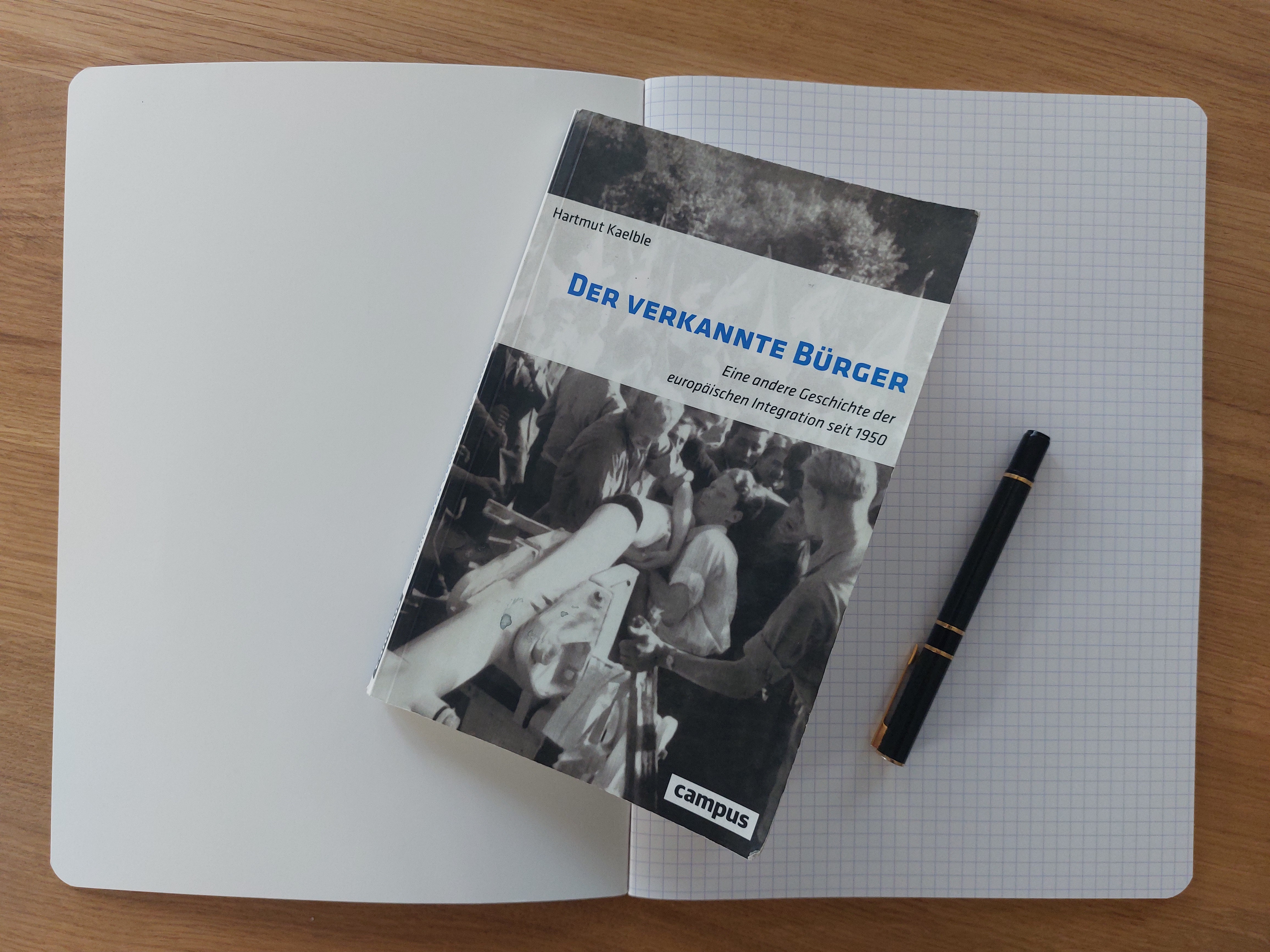



‘The Misunderstood Citizen – A Different History of European Integration since 1950’
Hartmut Kaelble wrote the approximately 160-page book after the crisis of 2008 to 2012 and the debates that followed. He examined three key issues in the relationship between citizens and the European Union: their trust in Europe, their expectations of Europe and their influence in Europe. (p. 9) In his view, the relationship between citizens and the EU has been given too little attention in discussions to date, ‘even though it is ultimately up to the citizens whether the European Union continues to flourish or declines.’ (p. 10)
The European promises to citizens and their fulfilment (pp. 23–54)
According to Kaelble, trust is created when the promises made in European politics are kept. Then citizens develop trust in the European institutions. Failure to keep promises, on the other hand, creates mistrust. According to Kaelble, the European Coal and Steel Community (ECSC) and the European Economic Community (EEC) stand for the two promises of peace and prosperity (including the resolution of serious crises). (pp. 24/25) Both can be considered to have been kept. (p. 26) Poorer countries such as Germany and Italy were able to catch up. (p. 27)
The promises of the European Community (EC): As a result of the oil price shock of 1973, the Paris Summit in December 1974 promised an economic and monetary union, a stronger political union, a coordinated common foreign policy, extended control rights and the direct election of the European Parliament (EP), as well as a uniform passport for the citizens of the then nine states. (p. 29). The EC established the Eurobarometer in 1973. (p. 33) As early as 1972, the promise of a social Europe and freedom of movement was also made in Paris. Due to economic circumstances, the gains in prosperity in the following years were ‘no longer so impressive and spectacular’. (p. 31) Disparities increased again, particularly with the accession of Greece, Spain and Portugal in the 1980s (p. 33). The promise of a democratised and social Europe could be considered ‘only partially fulfilled’. (p. 34)
The new promises made by the European Union from the 1990s until the euro crisis were, first, a common foreign and security policy in an expanded geographical area ‘to promote peace, security and progress in Europe and the world’. (p. 35). The second new promise was to stabilise democracy in the member states (Copenhagen criteria, 1993). (p. 36) The two new promises were added to the four older, existing ones. The economic gap between poorer countries and richer countries was narrowed. (p. 37) Peace was also maintained in the EU, and the promise of a social Europe was strengthened (European Social Fund, working conditions, fundamental social rights were included in the Charter of Fundamental Rights of Nice in 2000). The democratisation of Europe also made progress (p. 41) and peace in the geographical environment was not threatened. The six promises were therefore largely kept. (p. 44)
The financial and euro crisis from 2008 to 2012 led to greater economic disparities (p. 46) and increased economic and social divergences. The politicisation of the EU and the euro as a common currency led to more heated discussions than during the crisis of the 1970s. (p. 47). After the euro crisis, economic and social divergences have moderated. The last two promises – external security and safeguarding democracies in the member states – proved to be weak points in European policy. (p. 52) However, citizens do not base their relationship with the EU solely on the promises of European policy, but also had ‘independent, autonomous expectations.’ (p. 54)
Did citizens trust the European Union more in the past? (p. 55 – p. 80)
As early as the 1950s and 1960s, following the failure of the European Defence Community, a decline in support for the European idea could be observed. The Treaties of Rome led out of this trough (p. 57) into a ‘golden age’ that came to an end in the 1970s and early 1980s. (pp. 58, 59). One reason for this was the change of opinion in the United Kingdom, which had been a member of the EC since 1973. In Denmark, European integration was no longer supported by the majority of citizens. (p. 60) – ‘Eurosclerosis’ – A new upswing in public opinion on the European project began in the mid-1980s with the creation of the single market. (p. 61)
In the 1990s, until the euro crisis, the EU was divided, ‘very roughly speaking, into an enthusiastic south and a sceptical north.’ (p. 63) The causes were the politicisation of the EU, a general loss of trust in politics and a ‘dead end of expectations’ due to the expansion of competences under the Maastricht Treaty. (p. 65) In addition, the EU left it to the nation states to explain and promote European integration. (p. 66)
From 1997 to 2009, broader support from citizens was regained. (p. 67) In the crisis of confidence that followed the financial and euro crisis, vocal members of the elite now also publicly opposed European integration (e.g. Germany). (p. 70) Once again, EU citizens were divided, but in the crisis the division was rather the reverse. ‘The European Union lost its base among the citizens of the south.’ (p. 71) In ten out of 27 countries, the negative image of the EU prevailed. (p. 71) Importantly, even in this situation, an overwhelming majority continued to believe that European responses to the crisis were necessary. (p. 72)
As the economy improved, public support rebounded, and citizens often trusted the EU more than their national governments. (p. 72) Some sceptical attitudes remain as a result of the financial and euro crisis and the dissent in the European Council on migration and the separation of powers. (p. 74) Three continuities are: Europeans' identification with Europe, citizens' support for an EU with strong powers beyond the customs union, and the EU's liberal political identity. (p. 76)
In summary, it can be said that the EU lost support four times in roughly 20-year cycles. (p. 77) However, this support was largely regained through European policy decisions. (p. 78)
Citizens' own expectations of Europe (pp. 81–112)
‘If one always views the European Union as an elite project, sees citizens as trapped in apathetic acceptance or blind resistance to the future, and thus pushes them to the margins of the history of European integration, these expectations and hopes cannot be recognised. These expectations often do not coincide with European policy. They have their own history.’ (p. 9)
Kaelble's thesis: Citizens were not only guided by European policy, ‘but also measured European policy against their own distinct ideas of European integration.’ (p. 81) Two ideas of Europe held by citizens can be distinguished here: on the one hand, the debates about an EU that, with more powers, also had more influence on their everyday lives. On the other hand, there were citizens' expectations of a ‘virtual Europe beyond the competences of European policy,’ which often went unheeded but, in historical retrospect, often proved to be far-sighted. (p. 82) Citizens did not simply follow European policy. Firstly, they never saw European integration as merely an economic project, ‘but always as a project with political goals.’ Secondly, they ‘often had broader and different ideas about the European economy than European policy.’ They did not simply accept European policy, but wanted more influence and more information. (p. 83)
As early as 1962, a survey showed that almost all respondents wanted a common research policy, harmonisation of professional qualifications and equal social benefits. (p. 84). In the following period, the 1970s and early 1980s, two-thirds of citizens wanted a common European foreign policy, especially towards the USA and the USSR. (p. 86) They also expected the EC to take action in policy areas such as energy, the environment and the fight against inflation and unemployment. (p. 87) In 1976, Eurobarometer stopped asking questions about citizens' expectations and resumed doing so in the early 1980s. (p. 88) During these years, two-thirds of citizens wanted more power for the European Parliament (EP). (p. 89) Conclusion: At that time, there was a wide gap between citizens' expectations and the reality of European policy.
Citizens' political expectations continued in the late 1980s, partly as a result of accelerated globalisation. (p. 90). With regard to the single market, which was to be completed in the 1990s, around 80 per cent of citizens see advantages for themselves. (p. 91) Half of those surveyed wanted a stronger European Parliament. However, citizens were divided on this issue depending on their country. But only 39 per cent were interested in European politics. In the first half of the 1990s, citizens continued to see the EU primarily as a political project, but the majority in favour of it was shrinking. More demands (such as social policy) were again being directed at the nation state. (p. 93) The Maastricht Treaty was viewed positively. (p. 94) Furthermore, a majority hoped for more power for the Parliament. (p. 95) Overall, however, the discrepancies between citizens' expectations and the priorities of European policy became greater again. (p. 95)
From the late 1990s until the euro crisis, citizens also saw the priorities of European policy in political issues. (p. 96) However, expectations of the EU declined somewhat and, in some policy areas, shifted back towards the nation state (combating unemployment and inflation). (p. 98) The EU is viewed negatively in terms of immigration policy. During the crisis from 2009 to 2012, the economy – crisis management – once again came to the fore in terms of expectations. (p. 101) However, due to tensions within the EU, peacekeeping was almost on a par with this. Freedom of movement is considered one of the most important achievements. (p. 102) Confidence in the EP declined significantly. (p. 103)
After the crisis, the EU's political goals experienced a ‘comeback’, partly due to international tensions, the refugee crisis and Islamist terrorism. (p. 104) The common security and defence policy was a high priority, but the EU had no competence in this area or was divided. The majority of citizens reject immigration from outside the EU and further enlargement of the EU. (p. 105) In 2017 and 2018, almost three-quarters of respondents approved of the economic and monetary union with the euro. (p. 107) Outside the euro area, however, it is rejected. The majority of citizens continue to want a stronger European Parliament. (p. 108).
The European influence of citizens (pp. 113–156)
Did citizens' ideas influence the European Commission and the European Council? ‘Were citizens a serious player in the history of European integration?’ (p. 113)
Collective influence: elections, referendums, movements, interest groups
Elections: Declining voter turnout was explained by: political fatigue, European fatigue (although identification with Europe has fluctuated little over the decades), countries with compulsory voting lost influence due to enlargement, election fatigue in the new member states, a lack of alternatives in election campaigns, and the disinterest of national parties, which did not found European parties and only wanted to fill their coffers with European election subsidies for their national elections. (p. 119) Only gradually were there signs of change (‘lead candidates’). (p. 120)
European referendums mobilised more than elections, but they had a disadvantage: European referendums were limited to individual member states. After the shock of the lost referendums in France and the Netherlands in 2005, referendums are now considered unpredictable even by some of their supporters. (p. 121) The failed referendums dealt with fundamental issues, but referendums on more limited treaty changes are also conceivable. Furthermore, the referendums held to date have not brought about any increase in European democracy. (p. 122) This is because a truly democratic referendum would require all EU citizens to be consulted. The referendums held to date have therefore not been a shared European experience. ‘The actual democratisation of the European Union through referendums is therefore still to come.’
European movements (p. 123): The Union of European Federalists lost its character as a movement and had only 20,000 members left. It was not until 2017 that a European mass movement emerged again with Pulse of Europe. (p. 125) ‘In normal times, the majority of citizens saw no need to get involved in a movement that was only concerned with the fundamental existence of Europe. Citizens wanted instead to achieve their specific goals within the existing EU.’
Interest groups: In the 1950s, industry, agriculture and trade organised themselves. (p. 126) European trade unions and citizens' organisations were initially completely underrepresented. This changed with the expansion of the EC's decision-making powers, and the number of NGOs in particular increased. (p. 128) However, these organisations have smaller budgets and employ fewer staff. The influence of trade associations, on the other hand, can be seen in the adoption of individual directives. (p. 130) The European Commission and the EP began to counteract this asymmetry in interest representation as early as the 1970s, for example by promoting consumer, environmental and citizens' organisations. (p. 132) Since 2011, there has been a joint, transparent lobby register for the Parliament and the Commission. Consultations with lobbyists have also been regulated and take place in various forms. (p. 134) In 2008, a code of conduct for interest groups was developed. The aim is to maintain control and independence in decision-making, while utilising the expert knowledge of interest groups. In 2017 (?), 12,000 lobbyists were registered in Brussels. (p. 129) National interest groups, which citizens could join themselves, also set up offices in Brussels. (p. 137) This further promoted the ‘citizen-friendliness of European interest representation’. (p. 139)
Individual influence of citizens: complaints, lawsuits, petitions (p. 139)
Complaints to the European Commission: Citizens can complain about national standards and measures if they violate EU law. (p. 139) Surprisingly, the Commission does not report on this in detail. (p. 140) 1982: 352 complaints, 2016: 3,783 complaints. With the change in European policy, complaints also shifted towards political and social issues. (p. 141)
Legal action before the European Court of Justice (p. 143) has been possible since the beginning of the Community for Coal and Steel. In 2014, there were 1,423 cases pending before the European Court of First Instance, around half of which were direct actions brought by citizens and businesses. In 2014, there were 622 cases pending before the European Court of Justice of last instance, only 12 per cent of which were brought by citizens and businesses. Judgments also gain significance through the fact that case law has further developed European law. (p. 145)
The petition to the European Parliament was introduced after the first direct European elections in 1979 and has been very influential – i.e. effective. All citizens and legal entities have the right to petition. Petitions are only accepted if they concern the EU's sphere of activity. This influence is being used increasingly: while there were just over 200 petitions in 1985, a peak of over 3,000 petitions was reached in 2013. (p. 146)
Complaints to the European Ombudsman, elected by Parliament for a five-year term, are an established instrument, but have not led to new decisions. (p. 151)
The European Citizens' Initiative, launched in 2012, is a complex undertaking: it requires one million signatures from seven countries to be collected within one year. This results in a proposal for action to the Commission, which is then merely required to consider it. The aim is therefore to put an issue on the agenda. ‘Only four citizens' initiatives had been successful by 2017.’ (p. 152)
Conclusion (pp. 157–162)
‘Since the euro crisis and the refugee crisis, however, the European Union's promises have become increasingly difficult to keep.’ (p. 158) ‘Instead, European policy has had to fight for the trust of European citizens in every crisis with its new issues.’ (p. 159) The promises of the 1990s, namely peacekeeping in the EU's neighbourhood and safeguarding democracy and European values in the member states, encountered difficulties. Among other things, the war in eastern Ukraine and Russia's annexation of Crimea became difficult challenges.
According to Kaelble, citizens' ideas about European integration differed from actual European policy in three respects:
Firstly, they hoped ‘from the outset for political union, greater European integration in foreign policy, defence, the protection of human rights, the fight against terrorism, environmental protection, research and innovation policy, international energy policy and, from the 1950s to the 1990s, social policy as well’. (p. 160)
Secondly: Citizens often wanted a different economic policy, but appreciated the single market and freedom of movement within Europe. Expectations changed over the decades.
Thirdly: Since the first direct European elections, citizens have wanted more influence through a more powerful Parliament.
Summary: Margit Reiser-Schober
Errors in the text? Errors in the translation? – eurolandpost(at)gmx.eu
Machine translated with deepl
- Hartmut Kaelble
https://de.wikipedia.org/wiki/Hartmut_Kaelble
- „Der verkannte Bürger“ – Eine andere Geschichte der Europäischen Integration seit 1950“
Frankfurt am Main 2019
https://www.campus.de/buecher-campus-verlag/wissenschaft/der_verkannte_buerger-15358.html